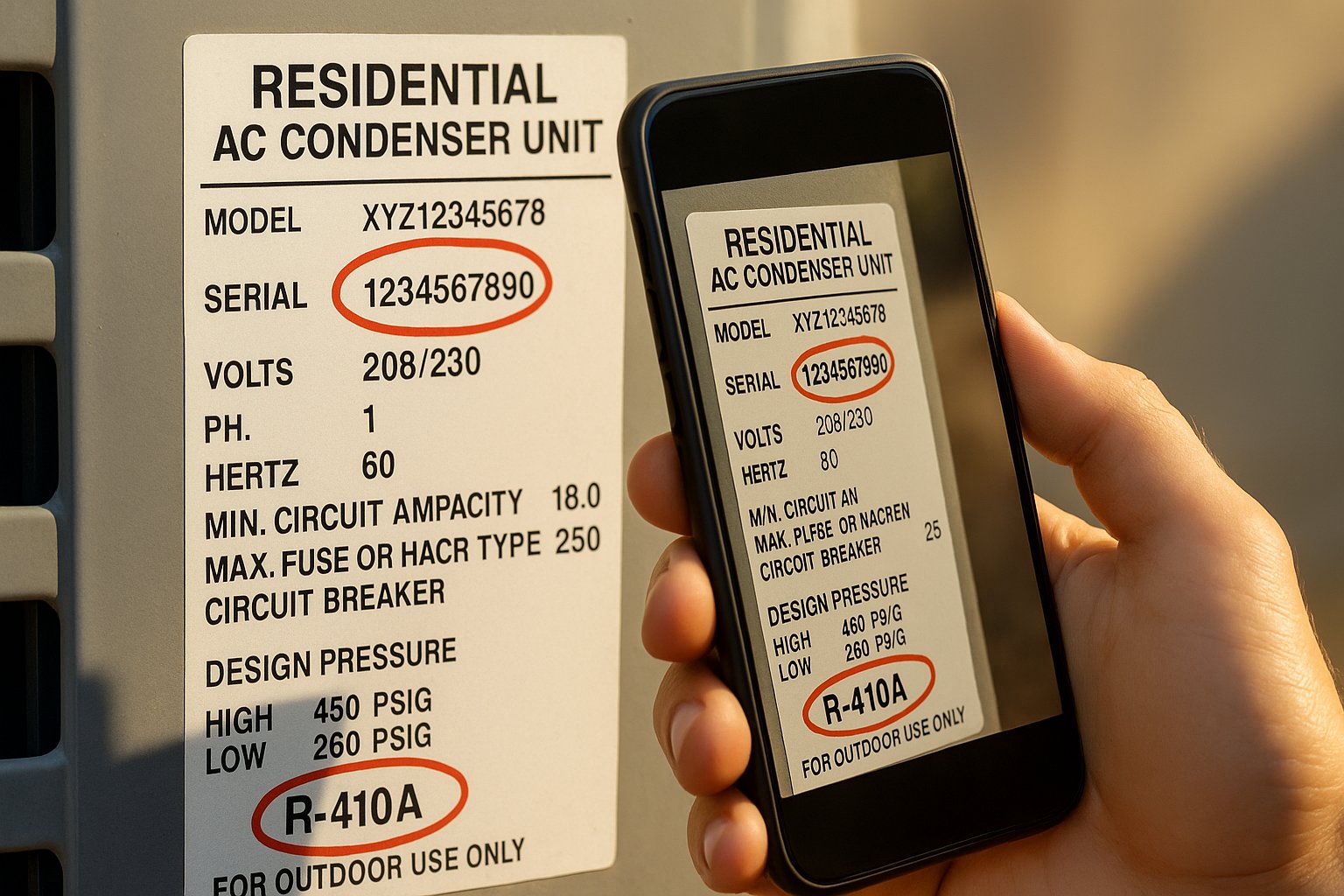
Read Your AC Label Before Any Tech Arrives
Before a technician says one word about replacing your system, there are two numbers on your outdoor unit that tell you whether to believe them. Most Orange County homeowners never look at them. That is exactly why some contractors count on it.
This guide will show you how to read your AC unit label in under five minutes — no tools, no training, no HVAC background required. By the time you finish, you will know your system's age, its refrigerant type, and whether a replacement conversation is worth having or worth pushing back on.
Why the Label Matters More Than You Think
Every residential AC system — whether it is a Carrier, Lennox, Trane, or any other brand — ships from the factory with a data label affixed to the outdoor condenser unit. That label is not just a serial number sticker. It is a compressed technical biography of your system. It tells you when the unit was manufactured, what refrigerant it requires, how much refrigerant it holds, its rated cooling capacity, and its electrical requirements.
For a homeowner in Orange County facing a repair call or a replacement pitch, two of those fields are worth knowing cold before any hvac technician walks through your gate: the manufacture date and the refrigerant type. Armed with those two data points, you are no longer relying entirely on what you are told. You have a reference point.
At Frost & Flame HVAC, our technicians will always show you what they find and explain it in plain language. But we also believe an informed homeowner is a protected homeowner. So here is how to read the label yourself.
Where to Find the Label on Your Outdoor Unit
Walk outside to your outdoor condenser — the large box-shaped unit typically sitting on a concrete pad on the side or back of your home. The data label is almost always located on one of the following surfaces:
- The upper portion of the unit's side panel
- The inside of the access panel door if the outer casing has been replaced
- Occasionally on the top of the unit near the fan grille
The label is usually white or silver with black printed text. On older units it may be weathered, yellowed, or partially obscured. A flashlight helps. On newer units the label is typically clean and easy to read. Take a photo of it with your phone so you have it for reference during any service call.
How to Decode the Manufacture Date
This is the single most important number to know. HVAC systems have a typical useful lifespan of 15 to 20 years in Southern California, though many Orange County units run in high-demand conditions that can push systems toward the lower end of that range. Knowing your system's actual age — not an estimate, the real manufactured date — gives you a factual baseline for any repair-versus-replace conversation.
The manufacture date is almost never printed in plain text as a month and year. It is embedded in the serial number. Every major HVAC manufacturer uses a slightly different encoding format, but the most common patterns are:
First four digits of the serial number (most common format): The first two digits represent the week of manufacture and the next two represent the year. For example, a serial number beginning with 2318 means the unit was manufactured in the 23rd week of 2018.
Letter-based year codes: Some manufacturers use a letter as the second character in the serial number to represent the year. Carrier, for instance, used a sequential letter system where specific letters corresponded to specific years. A quick search of your brand name plus 'serial number date decoder' will confirm which format your unit uses.
Four-digit year embedded in the middle: Some brands print the full four-digit year in positions three through six of the serial number.
Once you know your manufacture date, the math is straightforward. A system that is 8 years old with a repairable component failure is almost certainly worth fixing. A system that is 17 years old running on a refrigerant that is being phased out of production is a genuinely different conversation. The age does not make the replacement pitch right or wrong on its own — but it tells you whether the conversation is worth having at all.
How to Read the Refrigerant Type
The refrigerant field on your data label is printed clearly, usually labeled as 'Refrigerant,' 'Ref,' or 'Charge.' The most common designations you will encounter in Orange County residential systems are:
R-22 (also called Freon): If your unit label shows R-22, your system is at minimum 15 years old, because R-22 was phased out of new equipment production in 2010 and banned from manufacture and import in 2020. R-22 is now only available as reclaimed refrigerant, and its price has increased significantly as supply has tightened. A system running on R-22 that needs a refrigerant recharge is not just an aging-system problem — it is a supply and cost problem that legitimately changes the repair-versus-replace calculus.
R-410A (also called Puron): This became the standard residential refrigerant after R-22 was phased out. If your label shows R-410A, your system was likely manufactured between roughly 2010 and 2024. R-410A systems are still fully serviceable. Refrigerant is available. Parts are available. A replacement pitch on an R-410A system in good mechanical condition deserves scrutiny.
R-32 or R-454B: These are the newer low-GWP refrigerants now appearing in systems manufactured from 2025 onward, driven by EPA regulations targeting high-GWP refrigerants. If your label shows one of these, your system is new. Any replacement conversation is almost certainly premature.
Knowing your refrigerant type tells you one critical thing: whether refrigerant cost and availability are genuinely a factor in your service decision, or whether they are being used as leverage in a sales conversation.
What Else Is Worth Noting on the Label
While you have your phone out and the label in frame, photograph two additional fields:
Tonnage or BTU capacity: This tells you the size of the system. Residential units in Orange County typically range from 2 to 5 tons. If a technician recommends replacing your 3-ton unit with a 5-ton unit without a formal Manual J load calculation, that is a red flag. Bigger is not better in HVAC — an oversized system cycles on and off too frequently, fails to properly dehumidify, and can wear out faster than a correctly sized one.
Model number: Combined with the serial number, the model number lets you look up your specific unit's specs, warranty status, and known issues in about 60 seconds online. Most manufacturers publish this data publicly. A technician who knows you have done this homework tends to communicate more carefully.
How to Use This Information During a Service Call
You do not need to pretend to be an HVAC technician. You just need to be an informed homeowner. When a technician arrives, you can open the conversation simply: 'I looked at the label before you came — the unit is a 2014 model running R-410A. Can you walk me through what you are finding?'
That single sentence communicates three things. You know the system's age. You know the refrigerant is still serviceable. And you are asking for a walkthrough, not just an invoice. A trustworthy hvac contractor will welcome that framing. A technician who pivots immediately back to replacement talking points without addressing the specific failure is worth questioning.
At Frost & Flame heating and cooling, our process starts with a full diagnostic before we mention replacement. We show homeowners exactly what we found, explain what it means in plain language, and price the repair and the replacement side by side with straight, upfront numbers — no vague ranges, no surprise charges at the end of the job. That is what transparent indoor comfort solutions look like in practice.
When a Replacement Pitch Is Actually Legitimate
This guide is not about teaching homeowners to reflexively resist every replacement recommendation. Sometimes replacement is the right call, and a good hvac technician will be able to explain exactly why with specifics.
Legitimate reasons to seriously consider replacement include: a system over 15 years old with a compressor failure (the most expensive single component to replace), an R-22 system that needs a significant refrigerant recharge, a system that has required multiple repairs in the past two to three years with costs accumulating toward the price of replacement, or a unit that is significantly oversized or undersized for your home's current square footage and insulation profile.
The key word is specifics. A technician who says 'this system is old and it is just going to keep breaking' without pointing to a concrete failure mode, a parts cost, or a documented efficiency loss is giving you a sales pitch, not a diagnosis. A technician who pulls up the data, shows you the compressor amperage reading, explains that it is drawing 40 percent over rated capacity, and tells you what that means for the next 12 months — that is hvac maintenance and diagnostic work done right.
For qualifying replacement systems, Frost & Flame HVAC targets a 30 percent reduction in the homeowner's monthly power bill through properly sized, high-efficiency equipment. That is a measurable outcome tied to a real investment, not a vague promise about 'energy savings.'
Your AC Label Is Your First Line of Defense
Temperature control in an Orange County summer is not optional. When your system fails or starts struggling, the urgency you feel is real — and some contractors count on that urgency to short-circuit your judgment. The data label on your outdoor unit takes about five minutes to read and photograph. It costs nothing. And it puts factual information in your hands before anyone starts talking numbers.
Know your manufacture date. Know your refrigerant type. Know your tonnage. Then listen to what your technician says and measure it against what you already know.
If you want a local hvac company that will walk you through exactly what the diagnostics show before any replacement conversation starts, Frost & Flame HVAC is available 24 hours a day, seven days a week, with real humans answering the phone — not a robot, not a voicemail. Straight, upfront pricing on every call. Same-day emergency hvac service across all eight Orange County service zones.
Call Sienna at Frost & Flame HVAC. She will get you scheduled and make sure you know exactly what to expect before a technician arrives.