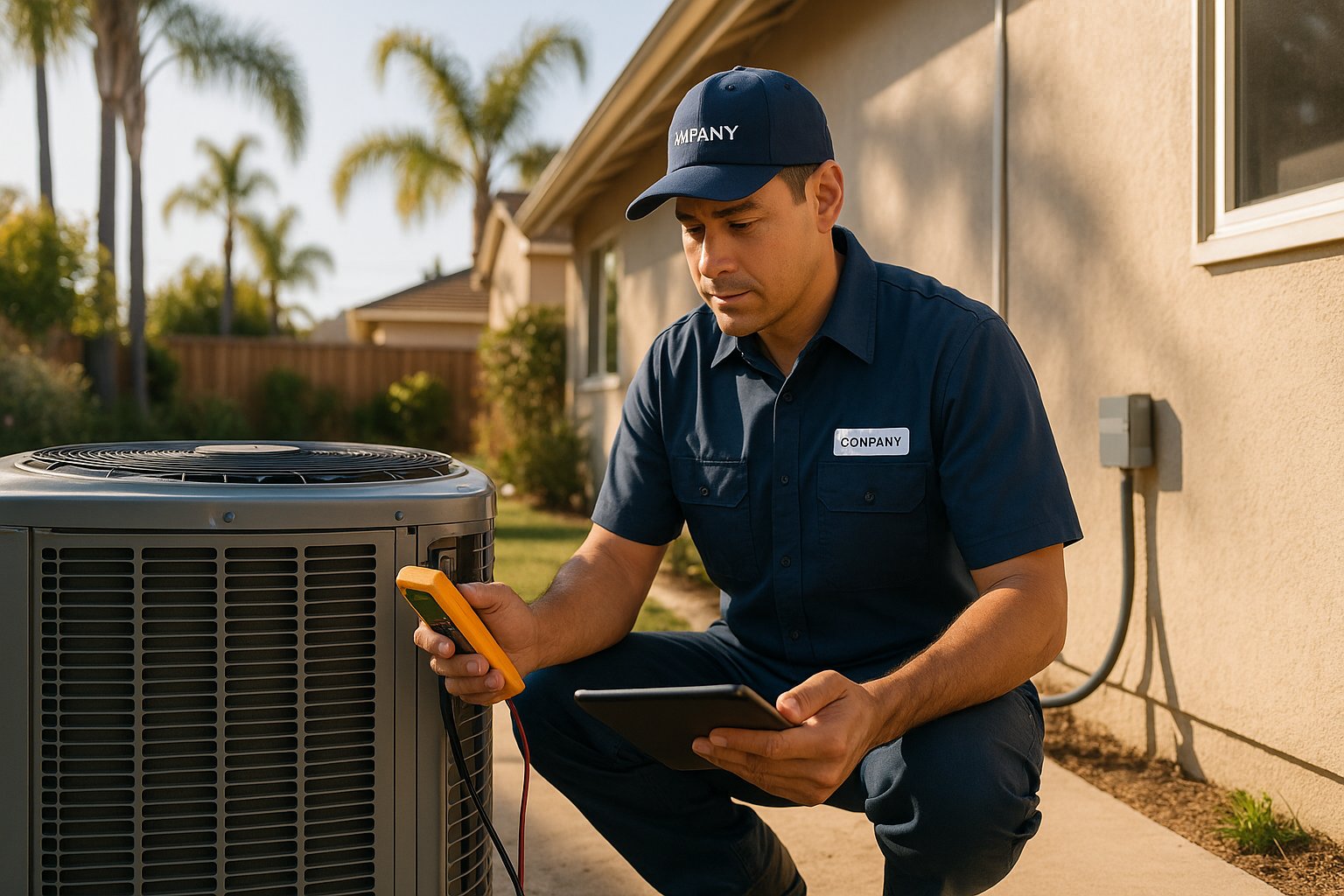
What a Real HVAC Tech Checks Before Saying Anything
You called because your AC stopped keeping up. It is 94 degrees in Orange County, the kids are home, and you need answers fast. A technician shows up, glances at the unit for about three minutes, and tells you the system is shot. You need a full replacement. That will be $11,000.
Here is the question nobody asks in that moment: what exactly did he check?
At Frost & Flame HVAC, our technicians follow a structured 10-minute diagnostic protocol before they say a single word about repair or replacement. Not because we are slow. Because getting the diagnosis right the first time is what separates an honest hvac contractor from one running a sales script.
This is exactly what happens in those first 10 minutes on every same-day call we run across Orange County.
Step 1: The Thermostat and Control Verification
Before any hvac technician touches the equipment, the smartest place to start is the one homeowners almost never think about: the thermostat. A surprising number of service calls that look like major system failures trace back to a thermostat set incorrectly, a dead battery, a tripped circuit, or a wiring issue that takes ten minutes and almost no parts to resolve.
Our tech confirms the thermostat is calling for cooling, checks the mode and setpoint, and verifies the display is communicating with the air handler. If the system is not receiving a proper signal, everything downstream is a guess. We do not guess.
Step 2: The Electrical Panel and Disconnect Check
Next is the electrical panel and the outdoor disconnect. A tripped breaker or a blown fuse is not a system failure. It is a symptom. Before a Frost & Flame heating and cooling technician opens the outdoor unit, he checks the breaker condition, inspects the disconnect box for signs of arcing or heat damage, and confirms voltage is reaching the equipment.
This step matters because a tripped breaker that keeps tripping is telling you something specific. It is not the same problem as a breaker that tripped once during a power surge. The electrical picture shapes everything that comes next in the diagnostic.
Step 3: Outdoor Condenser Visual Inspection
Now the tech looks at the condenser unit itself. Not just a glance. A deliberate visual scan that covers the condenser coil for debris, damage, or heavy fouling, the refrigerant lines for signs of icing or oil staining that indicates a leak, the contactor and capacitor for visible burn marks or bulging, and the fan blade for cracks or wobble.
In Orange County summers, condenser coils clog with cottonwood, dust, and debris faster than most homeowners realize. A severely fouled coil can cut system efficiency by 30 percent or more and cause high-pressure trips that look exactly like compressor failure. A tech who skips this step and goes straight to refrigerant diagnosis is skipping the most common cause of poor cooling performance in Southern California.
Step 4: Capacitor and Contactor Testing
Capacitors and contactors are the two most commonly replaced components on residential AC systems, and they fail more often in peak summer heat. Our hvac technician pulls the capacitor and tests it with a meter rather than eyeballing it. A capacitor that reads within spec but is borderline weak gets noted and disclosed to the homeowner with the actual number, not a vague 'it's getting old.'
The contactor gets a visual check for pitting and a voltage test under load. A pitted contactor causes hard starts that shorten compressor life. Catching it early is a $150 fix. Missing it turns into a $2,000 compressor replacement inside 18 months. This is what honest hvac maintenance looks like in practice.
Step 5: Refrigerant Pressure Readings
This is the step most homeowners have heard of, and it is also the step that gets misused most often. Refrigerant pressure readings tell you a lot, but only in context. Low suction pressure means something different depending on ambient temperature, indoor return air temperature, airflow across the evaporator, and system age.
A Frost & Flame tech takes static and operating pressures, notes the outdoor ambient temp and indoor return air temp, and interprets the readings against the manufacturer's charging chart for that specific unit. He does not tell you the system is low on refrigerant and quote a recharge without first identifying why it is low. Refrigerant does not disappear. If it is low, there is a leak, and adding refrigerant without finding the leak is selling you a temporary fix at a permanent-fix price.
Step 6: Airflow Measurement at the Supply Registers
Poor airflow is one of the most under-diagnosed causes of comfort complaints in residential heating and air conditioning systems. Our tech walks to at least two supply registers with an anemometer or measures static pressure at the air handler to assess whether the system is moving adequate air volume.
A system that is fully charged and mechanically sound but starved for airflow will still fail to cool the home effectively. The culprits are usually a clogged filter, a collapsed duct, a closed damper, or an undersized return. None of those require a new system. All of them require a tech who bothers to check.
Step 7: Evaporator Coil and Air Handler Inspection
If access allows, the tech inspects the evaporator coil for ice, dirt buildup, or restricted drain lines. A frozen evaporator coil is not a refrigerant problem. It is usually an airflow problem or an operating condition problem, and treating it as a refrigerant problem is one of the most common unnecessary upsells in the HVAC industry.
The condensate drain line gets a quick check as well. A blocked drain causes water damage and trips the float switch, which shuts the system down entirely. It looks like a system failure. It is a $75 drain flush.
Step 8: Compressor Amp Draw
The compressor is the most expensive single component in a residential AC system. Testing its amp draw under operating conditions tells the tech whether it is working within spec, struggling, or on its way out. Our technician clamps an ammeter on the compressor leads and compares the reading to the rated load amps on the nameplate.
A compressor drawing significantly over its rated amps is under stress. One drawing well under rated amps may have a failing start winding. Neither condition means automatic replacement. Both conditions mean the homeowner deserves an honest explanation of what the number means and what the realistic options are, including cost ranges for each.
Step 9: System Age and Service History Review
Before any recommendation is made, our tech asks about the system's age and any prior service history. A 14-year-old system with a failing compressor gets a different conversation than a 6-year-old system with the same reading. The repair-versus-replace calculus depends on remaining useful life, efficiency gap, and the homeowner's actual financial situation.
This is where temperature control decisions get real. We do not push replacement on a system that has five good years left. We also do not patch a system that is going to fail again in 90 days and leave a family without cooling in August. Honest guidance means saying the real thing, not the thing that generates the higher ticket.
Step 10: The Findings Summary Before Any Quote
Only after all nine steps above does a Frost & Flame technician sit down with the homeowner and walk through what he found. Not a sales presentation. A findings summary. Here is what the system is doing. Here is what is causing it. Here is what it will cost to fix, with every line item explained. Here is what happens if you do nothing.
Straight, upfront pricing means the number you hear before the work starts is the number on the invoice when it ends. No surprise charges. No add-ons that appear after the tech has already opened the unit. No pressure.
Why This Process Exists
Frost & Flame built this diagnostic protocol because we are a local hvac company in a market full of shortcuts. Orange County homeowners have been burned by contractors who walk in with a replacement quote and a financing brochure before they have touched a single meter lead. We built our reputation on being the opposite of that experience.
We offer emergency hvac service 24 hours a day, 7 days a week, with real humans answering the phone at every hour. Not a voicemail. Not a callback queue. A person. Because when your AC dies at 10pm in July, you do not need a ticket number. You need someone who can actually help.
Our indoor comfort solutions are designed for the specific climate and housing stock of Orange County. We know the neighborhoods, the common equipment brands, the typical failure patterns for this region, and the rebate programs available to homeowners who qualify for high-efficiency replacements.
If you want to know what is actually wrong with your system before anyone mentions a dollar figure, that is exactly what we do.
Call Sienna
Call Sienna at Frost & Flame HVAC. She answers 24/7 and can get a technician to your Orange County home the same day. Straight pricing. No surprises. No upsells you did not ask for. Just an honest answer about your AC and a clear path to getting your home comfortable again.
You deserve to know what you are paying for before you pay for it. That is the only way we work.